By Jaime Boler
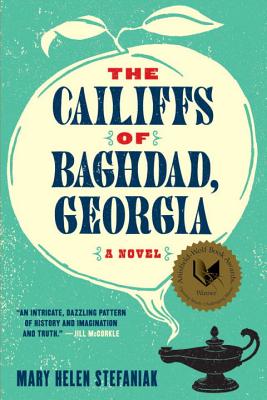 |
| The Cailiffs of Baghdad, Georgia ($15.95) |
Mary Helen Stefaniak: I began writing this novel in March 2003 after reading a newspaper story about the shock-and-awe bombing of Baghdad. I knew almost at once that I wanted to write a novel in which a group of Americans had a relationship to Baghdad—and everything Baghdad represents—that was different from the one being developed at the time. I wanted to remind anyone who happened to read the book that Mesopotamia is the cradle of our civilization.
JB: Do you have a favorite character in the story? If so, who and why? Which character is most like you?
MHS: My favorite character? I don’t know. To tell you the truth, I love them all. Well, maybe I don’t love Mr. Gordon and Mavis Davis, Sr., quite as much as I love the rest of them, but I do agree with whoever said that you have no business creating a character for whom you feel no sympathy.
The answer to which one is most like me has to be the same as Flaubert’s famous comment: “Madame Bovary, c’est moi!” They are all me in some way or another or I couldn’t have imagined them onto the page.
JB: Is the character May modeled on your grandmother Mattie? Was she also a storyteller?
MHS: I never met my grandmother Mattie. She died in childbirth with her sixth child.
JB: In a different time, do you think Ildred and Theo would have been more than just good friends? Or am I reading something that was not intended?
MHS: I think Ildred had strong feelings for Theo, and he obviously cared about her. They respected one another’s intelligence and understood each other’s value. Those are the kinds of feelings that could support a deep and lasting relationship.
JB: What does the white dirt, or kaolin, symbolize in your novel?
MHS: I don’t know that it symbolizes anything, but it is analogous to natural resources that have led to conflicts and exploitation in other parts of the world. As a defeated country occupied and exploited by victorious forces and plagued by terrorism in the aftermath of a bitter civil war, the American South has a history that is not unlike that of other countries that have been occupied and exploited by victorious forces and plagued by terrorism in the aftermath of a bitter civil war.
When Theo is pulled from the old kaolin pit, the deadly power of white dirt certainly suggests the deadly power of intolerance and hatred.
JB: What was the most difficult part of writing this story?
MHS: Keeping everything straight is tough whenever the story is long and complicated enough to be a novel, and simply persevering to the end was sometimes difficult, but the hardest part, as Hemingway once put it, was “getting the words right.”
JB: Your book is narrated by eleven-year-old Gladys Cailiff. Why did you choose to use the first-person narrative? Why did you choose Gladys as narrator?
MHS: I needed someone who would be perceptive and observant but also innocent, at the time—and someone who could be completely enamored with Miss Spivey.
JB: I had very mixed feelings about Miss Grace Spivey. On one hand, I applauded her for bringing life to Threestep and for opening the minds of her students to new cultures and a love of learning. Yet, she has an affair with a minor and seems naïve as to the consequences of the actions she sets in motion. What is your opinion of Miss Spivey? How did you come up with her? What do you think would have happened to her?
MHS: A reviewer named JoAnn Heydron described Miss Spivey as “cigarette-smoking, libidinous, and wildly generous.” I think that’s about right. I see her as a well-educated, highly privileged person who was really trying to do some good in the world but who wasn’t willing or able to suppress her own desires and interests while she did it. She probably has a lot in common with certain Teach for America volunteers of our own day. As for what would have happened to her, I think she would have gone back to her privileged life, back “home to her Daddy,” as Theo predicts when he’s arguing with Force about her, and from there, she would set out again on future adventures.
I asked one book club with a high proportion of teachers among the members to let me know what they thought of Miss Spivey, and they were kind enough to take notes on their discussion. They acknowledged that she wasn’t perfect—they were glad, at least, that Force was not one of her students—but they gave me a pretty long list of what they liked and admired about her, which included things like reading to the students, recognizing the importance of storytelling in teaching, the field trips, involving the whole community in school activities, valuing diversity (to put it mildly), and getting rid of the paddles. What kept coming up again and again, though, was Miss Spivey’s attitude toward state mandated requirements, which, for the most part, she ignored. Many of the teachers liked her for that. There was some feeling that state mandates reduced opportunities for creativity in teaching.
Miss Spivey did for Gladys and Threestep what good teachers always do for us: they transform us, they empower us, they endow us with a love of learning that lasts our whole lives—and then, in the vast majority of cases, they disappear from our lives before we’ve gotten wise enough to know what they’ve done.
JB: You make such a convincing case for the existence of Baghdad, Georgia, that I did some research and expected to find such a place. I was so surprised to learn you made it all up! What was your inspiration for creating this special town?
MHS: The name and the location and the one-and-a-half-room school house are inspired by the real town of Deepstep, Georgia, which claims to be the Kaolin Capital of the World.
JB: I was especially interested in the story of Bilali Mahomet. I’m a historian who specializes in slave culture and resistance. In some research, I came across African-American slaves who practiced Islam. One notable person was Ibrahima, who was an African prince brought to Natchez, Mississippi. His master renamed him Prince, yet Ibrahima still practiced some Islam. Did you know Bilali Mahomet would be in your novel when you set out to write your story or did you learn about him later?
MHS: I “discovered” Bilali Mahomet on a visit to Sapelo Island. I’d already been working on the book for close to three years at that point, and I needed a coastal island for purposes of the plot, so on our next trip to Georgia, my husband and I left my mother with her sister in Milledgeville and set out for the coast. We were in the visitor’s center, where you buy your tickets for the ferry and tour (on a schoolbus driven by a Park Ranger) of Sapelo Island, when my husband spotted something amazing in a display case: a picture of a little handmade notebook, lying open, its pages crammed with Arabic script! Just like that, I knew that I had found a real cultural ancestor for Theo Boykin, the smartest person in Piedmont County. I had even equipped Theo with a notebook before I learned about Bilali’s. I started reading in that direction and found out about other literate Muslims from West Africa who wound up enslaved in the Caribbean and in the Southern United States. And here I’d been thinking that it was kind of a stretch, to put Georgia and “Baghdad” together in one novel!
JB: I like how you have Bilali Mahomet’s descendants naming their children Bilali. They may not know its original meaning, yet the name still means something to them. That was one of many historical accuracies I found in your book. How important is real history in writing historical fiction?
MHS: It’s funny, but I don’t think of The Cailiffs of Baghdad, Georgia as historical fiction, which I define as fiction whose purpose is to allow readers to experience a time other than their own. While I had to try and “recreate” rural GA in 1938-39 (not to mention the Arabian peninsula in 1916, the Georgia coastal islands in 1920 or so, a bit of General Sherman’s march to the sea, a journey from West Africa to Baghdad in 1775 or so, and scenes from 9th-century Baghdad), my purpose was not, primarily, to allow readers to experience those other times and places.
My primary purpose was to help readers (and myself) to see our own time more clearly. That said, whatever the novelist’s purpose in recreating another time in fiction, I think writers are obliged to be as accurate as possible in using historical events and details. My personal rule for the use of history in my fiction, borrowed from Donald Barthelme, is simply: “It does not contradict what is known.” You can find long, windy essays on the subject of using history in fiction, but I think Barthelme pretty much says it all in those seven words, which I try to live by.
JB: I read where your mother went to the same high school as Flannery O’Connor. Peabody High School in Milledgeville, Georgia. Your mother graduated in 1943 and O’Connor in 1942. Did they know each other? Were they friends? What is your literary relationship with O’Connor?
MHS: I was in high school when I found out about that. Somehow, knowing that my mother had gone to school with the author of one of the stories in the anthology we were reading in English class, that she and O’Connor walked down the same school hallways, and so forth, made it seem more possible to be a writer. And the stories she wrote! They made you believe in the power of fiction, that’s for sure. My mother and her sisters knew who she was, but they belonged to the socioeconomic class from which she drew many of her characters, rather than the one to which she herself belonged. Maybe that’s one reason why I felt so pleased to have my mother and her sister and some cousins in the audience when I did a reading in the dining room at Andalusia, the O’Connors’ farm outside Milledgeville (where Flannery lived and wrote during the most productive years of her short life). As I have said on other occasions, pretty much everything I’ve ever written has been a tribute to Flannery O’Connor and at the same time an argument with her.
JB: You and your husband John live in a 150-year-old stagecoach inn you restored. What is it like living there? Could there be a future story there?
MHS: There are a hundred future stories there, but I haven’t written any of them yet.
JB: I read a review that compared The Cailiffs of Baghdad, Georgia, to Harper Lee’s To Kill a Mockingbird. But you really turn Harper Lee’s work on its head. Can you talk about that?
MHS: I read To Kill a Mockingbird for the first time in a Great Books program. I was twelve or thirteen. I loved it immediately. I’ve read it several times since. I owe a debt of gratitude, as a reader and as a writer, to Harper Lee, but as you say, there are some ways in which The Cailiffs of Baghdad, Georgia turns To Kill a Mockingbird upside down. If Atticus Finch is the best read person in Maycomb, Alabama, then his counterpart in The Cailiffs of Baghdad, Georgia is a 17-year-old African American named Theo Boykin. (Not only that, but the only lawyer in Threestep happens to be the Grand Goblin of the local KKK.) In my novel, I wanted to give some credit to the less fortunate classes, both black and white.
JB: What was your reaction upon learning your novel received the 2011 Anisfield-Wolf Book Award for fiction, an award that recognizes books that contribute to our understanding of racism and appreciation of diversity?
MHS: As I told the audience at the award ceremony in Cleveland, I was so thrilled to learn that people like the members of the Anisfield-Wolf award jury—Henry Louis Gates, Jr., and Joyce Carol Oates and Rita Dove and Stephen Pinker and Simon Schama–had read my book that they wouldn’t even have had to select it for the award. Just knowing that writers and thinkers of their stature had read my work was so exciting. Of course, I’m glad they chose it for the award, too. If you go to the Anisfield-Wolf website and see the books and authors who have won the award in its first 75 years, you’ll have some idea of how honored I feel to have my book be among them.
JB: Who has influenced you the most in your writing?
MHS: I don’t know who has influence me the most, but I’ve learned a lot from Flannery O’Connor.
JB: You grew up in Milwaukee, Wisconsin, and vacationed in Georgia. How was segregation different in the two very different places?
MHS: A librarian in Macon, Georgia, once told me, “In the North, segregation was spatial. In the South, it was psychological.” Growing up in the 1960s in a working class neighborhood on the south side of Milwaukee, I had no occasion to meet or speak to an African American until I went to high school. By contrast, in the little town where my aunt Sissie lived in Jones County, Georgia, her neighbors across the street were black, as were the families who lived down the road behind her little house. Not that I didn’t know there were official rules separating blacks and whites in Georgia. But I can also remember thinking, as a kid, that the reason there were no “whites only” signs on drinking fountains in Milwaukee—we call them bubblers there—probably was that the nearest African American was likely to be miles away from that bubbler, there being no black people in sight.
JB: Did you find any people, events, or issues in your research for The Cailiffs of Baghdad, Georgia, that you would like to return to someday?
MHS: Issues, yes. I think it’s so instructive to realize that racism is the same and different—in its manifestations and its targets—from generation to generation. I’ve made some notes for a novel starring the interracial couple we meet in The Cailiffs of Baghdad, Georgia: Ralph Ford, who saved Gladys Cailiff’s daddy, you may recall, in the Great War, and Lily. Ford, I’ve decided, is from Milwaukee, where he grew up in an Italian neighborhood in the Bay View area (not far from the house where we lived with my Croatian/Hungarian grandparents when I was very small). Ralph Ford’s father went through hell and high water in the 1890s, let’s say, to win permission to marry Ralph’s mother, who was the child of Italian immigrants. He had to convert to Catholicism and move in with his in-laws before they would give their blessing. His own English/Irish/German-American family disowned him in the meantime. His son Ralph Ford, who “grew up Italian,” may have hoped that his family would accept his marriage to Lily because of the obstacles that his own parents faced back when Italians and other Southern Europeans were “blacks” as far as white Anglo-Saxon Protestants were concerned.
JB: What do you hope readers take with them after reading The Cailiffs of Baghdad, Georgia?
MHS: A different, more intimate and affectionate, feeling about the word “Baghdad” and the whole broad swath of history and culture that word represents—and more awareness of the long history of Islam in the U.S. (I also hope that Gladys and Mavis and Force and Theo will live in their hearts forever!)
JB: What’s next for you? I read where you were working on something that involved baseball?
MHS: The truth is that I’m working on three projects—two fiction projects and one nonfiction—waiting to see which one demands to be next. Baseball plays a part in two of the three.